Showing posts with label steven sharratt. Show all posts

Monday, July 06, 2015

Bonus SoundCast - Remembering James Horner


Bonus SoundCast - Remembering James Horner


Bonus - The Soundcast Remembers James Horner

The Soundcast and Tracksounds team come together to talk about composer James Horner.  The team has a bit of a group therapy session as they share their own stories of the first time they each took note of the name, "James Horner," their thoughts on his lasting legacy in the film music genre, the score that epitomizes James Horner's work.  The main points of discussion are divided by clips from some of James Horner's lesser known, yet no less compelling, works.

Episode Highlights

00:00 — Introduction
04:22 — Hearing the bad news
10:09 — Our first James Horner score
21:48 — James Horner's place in history
34:23 — Some personal stories
41:22 — The epitome of James Horner
08:51 — Introduction to special tribute
36:08 — Close


Music Selections

00:00 — "There's No Goodbye ... Only Love" (Perfect Storm) by James Horner
19:48 — "A Far Away Time" (To Gillian on her 37th Birthday) by James Horner
33:35 — "Time Brings All Things To Light ... I Trust It So" (All The King's Men) by James Horner
40:15 — "Fresh Water" (Black Gold) by James Horner
52:33 — "Fallen Friends" (In Country) by James Horner


Support Tracksounds:


Most of the  soundtracks mentioned in this episode can be found at Amazon.  Your purchases through these links help us to keep on keepin' on!  Thank You!

Buy Soundtracks at Amazon.com


Download the Episode

Subscribe and More Info

Sunday, March 08, 2015

SoundCast Ep. 80 - The 2014 Cue Awards


SoundCast Ep. 80 - The 2014 Cue Awards


Episode 80 - The Cue Awards 2014 

The 7th Cue Awards are finally revealed!  Christopher Coleman, Marius Masalar, Edmund Meinerts, Richard Buxton, Thomas Medina, and Steven Sharrat, are joined by award-winning composers and record industry professionals to accept their awards.  All eleven award categories are announced as well as the winners of The Genius Choice Vote!  Additionally, Richard Buxton's spotlight on scores and composers from Asia returns with The Monkey King Award.

Episode Highlights

00:00 — Opening and Welcome to the 2014 Cue Awards
04:08 — How the Cue Awards Work
06:36 — Best Action Score: Cue Award and Genius Choice Award Winner
22:58 — What is The Genius Choice Vote?
23:35 — Best Dramatic Score: Cue Award and The Genius Choice Vote Winner
35:55 — Best Score for Television: Cue Award
38:11 — Best Score - Television: The Genius Choice Winner
45:10 — Best Score - Video Game: Cue Award and Genius Choice Winner
01:03:04 — Best Score - Animation: Cue Award and Genius Choice Award Winner
01:13:37 — Best Cue - Cue Award and Genius Choice Award Winner
01:22:55 — The Monkey King Award
01:26:31 — Record Label of the Year: Cue Award and Genius Choice Award Winner
01:36:06 — Best Theme: Cue Award and Genius Choice Award Winner
01:46:00 — Composer of the Year: Cue Award and Genius Choice Award Winner
01:50:05 — Best Overall Score: Cue Award and Genius Choice Award Winner
01:57:43 — Wrap Up and Spotlight Titles from 2014
02:11:14 — Credits and Thanks

Music Selections

00:01 — Cue the Orchestra by Marius Masalar
06:59 — Sun Wukong, The Monkey King (The Monkey King) by Christopher Young
11:35 — Niu Wo Wang, the Buffalo Demon King (The Monkey King) by Christopher Young
23:59 — Main Title (The Field of Lost Shoes) by Frederik Wiedmann
32:09 — The Imitation Game (The Imitation Game) by Alexandre Desplat
36:17 — Main Theme (Gunshi Kanbee) by Yugo Kano
38:34 — Main Theme (Game of Thrones) by Ramin Djawadi
45:50 — The Seeding (Civ. Beyond Earth) by Michael Curran, Geoff Knorr, Grant Kirkhope, Griffin Cohen
47:06 — Planetfall (Civ. Beyond Earth) by Michael Curran, Geoff Knorr, Grant Kirkhope, Griffin Cohen
47:46 — The Signal (Civ. Beyond Earth) by Michael Curran, Geoff Knorr, Grant Kirkhope, Griffin Cohen
51:49 — Planetfall Ambient Late 2 (Civ. Beyond Earth) by Michael Curran, Geoff Knorr, Grant Kirkhope, Griffin Cohen
54:49 — Xeno Titan (Civ. Beyond Earth) by Michael Curran, Geoff Knorr, Grant Kirkhope, Griffin Cohen
01:03:33 — Dragon Racing (How To Train Your Dragon 2) by John Powell
01:14:06 — The Future of Mankind (Civ. Beyond Earth) by Geoff Knorr
01:17:38 — Flying With Mother (How To Train Your Dragon 2) by John Powell
01:17:38 — Naoki Sato Suite - Arranged by Richard Buxton
01:17:38 — Son of Batman (Son of Batman) by Frederik Wiedmann
01:36:35 — A New Beginning (Civ. Beyond Earth) by Geoff Knorr
01:40:18 — Maleficent Flies (Maleficent) by James Newton Howard
01:46:24 — Opening Titles (Monuments Men) by Alexandre Desplat
01:50:43 — Two New Alphas (How To Train Your Dragon 2) by John Powell
01:50:43 — Should I know You? (How To Train Your Dragon 2) by John Powell


Notes:

Special thanks to:  Albert Tello (Costa Communications), Laura Engel (Kraft/Engel), Maria Klienmann (Walt Disney Music),  Dan Berry (Gorfaine Schwartz Agency)


Support Tracksounds:

You can purchase Marius Masalar's original piece "Cue The Orchestra" on Bandcamp!

Most of the  soundtracks mentioned in this episode can be found at Amazon.  Your purchases through these links help us to keep on keepin' on!  Thank You!

Buy Soundtracks at Amazon.com


Download the Episode

Subscribe and More Info

Friday, August 01, 2014

Film scores from the 2000s - Top 10 ‘Hidden Gems’

Film scores from the 2000s - Top 10 ‘Hidden Gems’

Film scores from the 2000s - Top 10 ‘Hidden Gems’
by Steven Sharratt

Following on from my article on Top 10 ‘Hidden Gems’ from the 1990s, here is the sequel, featuring unsung heroes from the years 2000 to 2009.

The ‘noughties’ was another great decade for film music. Classics that stand out include The Dark Knight, Gladiator, Inception, the Harry Potter franchise and The Lord of the Rings trilogy. I bet anyone reading this will have at least one of these soundtracks in their collection already!

Therefore, this top 10 is designed to help you discover a small fraction of ‘hidden gems’ from the 2000s. These scores aren’t necessarily the best from that decade – but they’re still great scores that have often been overlooked.  Hopefully it will help inspire you to discover some great new music.

(These scores are presented in chronological order and not in order of preference)

Dinosaur (2000) James Newton Howard

Dinosaur has not had the love and affection that most Disney animated films have and has largely been forgotten about. However, James Newton Howard’s score is very memorable, featuring heroism, romance and action, all brought together with an African inspired flavour.


If you like this you might also like to try: Atlantis (2001) James Newton Howard


Final Destination (2000) Shirley Walker

Shirley Walker scored the first three Final Destination films; unfortunately not a single note of her wonderful horror suspense scores has been officially released on album. Thankfully the region 1 DVD of the first film features a full isolated score track for you to enjoy. Also worth tracking down are Brian Tyler’s take on Walker’s main theme in The Final Destination (2009) and Final Destination 5 (2011).


If you like this you might also like to try: The Grudge (2004) Christopher Young

Final Fantasy: The Spirits Within (2001) Elliot Goldenthal

Final Fantasy was a very ambitious film at the time, creating what was then ‘state of the art’ animation. In typical Goldenthal style, his score brings an original and quite brilliant blend of lyrical beauty and dissonance. A true classic, not to be missed!


If you like this you might also like to try: S.W.A.T. (2003) Elliot Goldenthal

The Shipping News (2001) Christopher Young

Christopher Young stepped out of his comfort zone for The Shipping News and composed a truly engaging score featuring emotionally driven celtic music. It’s a lively and warm score and is a great departure from his typical horror sound. The opening ‘Main Title’ track is a real highlight.


If you like this you might also like to try: The Spitfire Grill (1996) James Horner

The Missing (2003) James Horner

Something about this 19th Century New Mexico drama must have really inspired James Horner, because here he brings back his true creative spark of the early 1990s. The score is both energetic and melodic and will send you on an emotional rollercoaster.


If you like this you might also like to try: The House of Sand and Fog (2003) James Horner

Steamboy (2004) Steve Jablonsky

If there’s one score that proves what creative talent Steve Jablonsky has it’s his score for the Japanese animated film Steamboy. Forget his clichéd power anthems for the Transformers franchise; Jablonsky here delivers a complex and exciting melodic orchestral score that comes highly recommended.


If you like this you might also like to try: Blood+ (2005) Mark Mancina

Pan's Labyrinth (2006) Javier Navarrete

Directed by Guillermo Del Toro, Pan’s Labyrinth is an excellent fantasy/horror set in Northern Spain in the 1940s. On scoring duties was the relative newcomer Javier Navarrete, who produced a wonderfully magical experience. For the main theme, Navarrete composed a beautiful lullaby featuring soprano, violin and piano. This is then emotionally manipulated and percussion is added as the film turns darker and darker. One of the best scores of the decade!


If you like this you might also like to try: Mama (2013) Fernando Velázquez

The Last Legion (2007) Patrick Doyle

Inspired by the last days of the Roman Empire, Patrick Doyle treats us to a symphonic fantasy action score, filled with heroism and choral grandeur. The film, featuring Colin Firth and Ben Kingsley, went largely unnoticed; the sweeping drama of this score might entice people to seek it out.


If you like this you might also like to try: Eragon (2006) Patrick Doyle

In Bruges (2008) Carter Burwell

The black comedy, In Bruges, allows Carter Burwell to showcase how to produce great dramatic intensity. He cleverly mixes melodic piano with percussive rhythms, whilst adding a wailing electric guitar for the action scenes. It won’t be to everyone’s tastes but it’s definitely effective in context of the film.


If you like this you might also like to try:  Conspiracy Theory (1996) Carter Burwell

Knowing (2009) Marco Beltrami

With nods to greats like Jerry Goldsmith and Bernard Herrmann, Marco Beltrami has produced a masterpiece of film composing for this average sci-fi thriller. Starting off with a dark and menacing orchestra, Beltrami expertly develops his themes into a truly dramatic and majestic score. Just listen to the track ‘Caleb Leaves’, an album highlight.


If you like this you might also like to try: Hellboy (2004) Marco Beltrami

Thank you for reading this article, I hope it has inspired you to find something new. We’d also love to hear your thoughts – what ‘hidden gems’ from the 2000s have you discovered?

Monday, April 28, 2014

Hidden Gems: Film scores from the 1990s

Film scores from the 1990s - Top 10 ‘Hidden Gems’

Hidden Gems: Film scores from the 1990s
by Steven Sharratt

We can’t all listen to everything. Who has the time? And particularly with film music, it’s sometimes difficult to discover that piece of music that might just be perfect to our tastes.

Film score collecting is quite a niche hobby and sometimes great film music doesn’t get the exposure it deserves. There are many factors why we sometimes don’t come across this music. Often it can be due to the film they’re attached to. Maybe that film has had poor reviews, or we don’t like the genre. Perhaps we didn’t like a composer’s previous work. Whatever the reason, I’m sure we’re all missing some great music from our collections.

The 1990s was a great decade for film music.  Just mentioning names such as Batman Returns, Braveheart, Jurassic Park, Last of the Mohicans, The Lion King, The Matrix, The Piano, Star Wars Episode I, Terminator 2 and Titanic will stir great memories for many of us.

However, this top 10 is designed to help you discover just a small fraction of ‘hidden gems’ from the 1990s. These scores aren’t necessarily the best from that decade – but they’re still great scores that have often been overlooked.  They’ve been picked to help you find something that you might not have thought of tracking down before.

We’d love to hear your thoughts too – what ‘hidden gems’ from the 1990s have you discovered?
(These scores are presented in chronological order and not in order of preference)

K2 (1991) Hans Zimmer

Not to be confused with Chaz Jankel’s score for the same film, Hans Zimmer scored the European version of K2. Here Zimmer crafts a perfect mix of symphony and synthetics giving us a great range of emotions from muscular drums and wailing guitars to tragic strings. The 40+ minute album released by Varese Sarabande is presented in just 2 tracks – “The Ascent” and “The Descent”, but give this one your full attention, you won’t regret it.


If you like this you might also like to try: Backdraft (1991) Hans Zimmer


Needful Things (1993) Patrick Doyle

Based on the horror novel by Stephen King, the score for Needful Things is a true classic from Patrick Doyle. It’s full of melodic energy for choir and orchestra. The attention to detail in the choral performances and the complexity of the string writing is to be admired. You will believe the devil is coming!


If you like this you might also like to try: Mary Shelley’s Frankenstein (1994) Patrick Doyle


The Adventures of Huck Finn (1993) Bill Conti

The 1993 adaptation of Mark Twain’s classic novel is another score full of orchestral melodies. This time Bill Conti provides us with spirited and uplifting music, cleverly weaving multiple themes together to give us a real sense of adventure. Just listen to the “Main Titles” track to see the joyous range of themes on offer here.


If you like this you might also like to try: Gold Diggers: The Secret of Bear Mountain (1995) Joel McNeely


Tombstone (1993) Bruce Broughton

Bruce Broughton brings the Wyatt Earp story to life with some really strong thematic material.  The main theme in particular stands out for its dramatic use of strings, horns and powerful drums. There is also plenty of thunderous action music to get your teeth into as well as some more sombre moments. A true underrated classic.


If you like this you might also like to try: Wyatt Earp (1994) James Newton Howard


Murder in the First (1995) Christopher Young

Murder in the First is a prison drama set on Alcatraz in the 1930s and 40s. Christopher Young’s score largely focuses on the emotional element of this. Here he cleverly interweaves three string themes to create a sense of both beauty and sadness. This feeling is peaked by the end of the album in the track “Redemption” when a choir is added and the strings soar to full effect.


If you like this you might also like to try: Copycat (1995) Christopher Young


Escape From L.A. (1996) Shirley Walker (and John Carpenter)

For this sequel to Escape From New York, John Carpenter reuses and updates his synthetic main theme to great effect. But it’s not until the latter half of the album when Shirley Walker combines some pulsating action music for both synths and orchestra that this score really starts to shine. Tracks such as “Hang Glider Attack” and “Fire Fight” are outstanding.


If you like this you might also like to try: Batman: Mask of the Phantasm (1993) Shirley Walker


Swept From the Sea (1997) John Barry

Swept From the Sea was one of John Barry’s last film scores and it is one of romantic beauty and longing. In typical Barry fashion, the music becomes darker with each passing cue, but the beauty is never lost and there is always a sense of hope. A masterwork that belongs in any soundtrack collection.


If you like this you might also like to try: My Life (1993) John Barry


The Postman (1997) James Newton Howard

Kevin Costner’s The Postman was universally panned by critics upon release, but there are pleasures to be had. One of them is James Newton Howard’s melodic and energetic score.  It’s full of heroism and dramatic rhythms, the best of which can be heard in the cue “The Restored United States”. I just wish that the sound mix on the Warner Brothers album was louder!


If you like this you might also like to try: Waterworld (1995) James Newton Howard


Snake Eyes (1998) Ryuichi Sakamoto

The main attraction of Ryuichi Sakamoto’s suspense score for Brian De Palma’s Snake Eyes is the wonderfully emotional theme for strings and solo horn. Highlights include a brilliantly re-orchestrated 7 minute suite at the end of the album and the dramatic bombastic track “The Storm” – a fitting nod to the great Bernard Herrmann.


If you like this you might also like to try: Little Budda (1993) Ryuichi Sakamoto


The Bone Collector (1999) Craig Armstrong

Don’t be put off by the mediocre thriller that this score is attached to, because Craig Armstrong is on true form here. The main theme is both edgy and emotional as Armstrong uses piano, synths and strings to portray the crime ridden New York Streets. This theme comes to a dramatic and rhythmic conclusion in one of the album highlights, “Pier Pressure”. The music never becomes dull and the album is a great listen from start to finish.


If you like this you might also like to try: Plunkett & Macleane (1999) Craig Armstrong


Did we miss any hidden gems from the 1990s?  If so, let us know in the comments!


Wednesday, December 18, 2013

Top Ten Science Fiction Film Scores

Top Ten Science Fiction Films Scores

Top Ten Science Fiction film scores
by Steven Sharratt

Science fiction has always been a regular feature throughout the history of film. As early as the silent film era we’ve had memorable takes on the genre such as Sir Arthur Conan Doyle's The Lost World (1920) and Fritz Lang's Metropolis (1927). In the 1930s H.G. Wells brought us Things to Come (1936) and we also saw the birth of the Flash Gordon and Buck Rogers characters in several low budget film serials.

Sadly, due to the events of World War II, science fiction wouldn't become popular again until the 1950s when the world was looking for escapism and they found it in the guise of aliens. The Day the Earth Stood Still (1951), The Thing From Another World and Invasion of the Body Snatchers all excited viewers with alien invasions. Meanwhile, When Worlds Collide (1951), The War of the Worlds (1953) and The Time Machine (1960) showed us that there was a taste for turning science fiction novels to the big screen.

The space race of the 1960s saw the focus shift to space travel with 2001: A Space Odyssey (1968) and Planet of the Apes (1968) both hugely successfully. But it wouldn't be until 1977 when George Lucas’ Star Wars arrived that the history of science fiction wouldn't be changed forever. The genre became a guaranteed money maker and all the major studios looked to cash in. We saw the Star Trek TV series become a film franchise in 1979 and other franchises started to grow throughout the 1980s and 90s such as Alien, Back to the Future, Terminator and Robocop.

Since the turn of the century, this trend has continued, most noticeably with The Matrix Trilogy. The recent focus has been on prequels and sequels (Star Wars, Planet of the Apes, Terminator), remakes (The War of the Worlds, Total Recall) and reboots (Star Trek, Robocop) but science fiction is still as popular as ever.

The genre has also often inspired composers to be at their most creative. Whether it is looking into the future, the past or into space, science fiction has produced some of the very best film scores. It’s also hard to pin down one particular style for the genre; composers have used various successful techniques over the years to help us to escape into an unknown world such as symphonic orchestras, synthesizers and unusual sound effects.

The purpose of this top ten is to discover which scores have been the most successful in portraying science fiction in film. But before you go straight to the list, there are a few things I’d like you to consider. Firstly, these are subjective views of just one person, so please don’t be too disappointed if your favourite score isn’t here. Secondly, to give a broader perspective, I've only included one score from a single franchise - it wouldn't be very entertaining to see a top ten littered with my bias towards Star Wars now, would it? Finally, I've tried to narrow science fiction down to its most true meaning – “fiction based on imagined future scientific or technological advances… frequently portraying space or time travel and life on other planets.” Therefore I’ve eliminated sub-genres. You won't find any super hero or fantasy movies in this list even though they often have sci-fi elements.

I hope this list generates some lively discussion; please do send us your own top ten, we'd love to know what you think and it might highlight some great scores that I may have omitted (“Blade Runner” anyone?).

Thank you and enjoy...


10. Tron Legacy (2010) Daft Punk

French Grammy award-winning electronic duo Daft Punk was given the rare chance to spread their wings into the world of film music with Tron Legacy. They took the option of using an 85 piece orchestra (something they’d never done before) and mixing it with their familiar synth sound. The results are excellent and provide a heroic and rhythmic soundtrack that really makes us believe the characters are trapped inside a digital world.


If you like this, you might also like:
Tron (1982) Wendy Carlos
Oblivion (2013) M83


09. The Day the Earth Stood Still (1951) Bernard Herrmann

Bernard Herrmann’s first taste of science fiction seems to be quite clichéd these days. This is because his brilliant and original score for The Day the Earth Stood Still has been so heavily influenced upon since. His unique use of two Theremin electrical instruments instantly makes people think of a UFO whenever they hear them. Another highlight is the bombastic brass theme for the robot, Gort, as well as some exciting action music. Don’t let the age of this one put you off!


If you like this, you might also like:
The Thing From Another World (1951) Dimitri Tiomkin
Mars Attacks (1996) Danny Elfman


08. Back to the Future III (1990) Alan Silvestri

Perhaps Silvestri’s original Back to the Future score would have been the obvious choice for a top ten, but this third instalment captures the iconic theme from the first two movies while bringing in fresh themes and melodies of its own. The love theme for Doc and Clara is simply beautiful and the over-the-top western overture blends in perfectly with the main heroic theme.


If you like this, you might like:
Back to the Future (1985) Alan Silvestri
The Abyss (1989) Alan Silvestri


07. Robocop (1987) Basil Poledouris

The cyber police officer Robocop, part-man, part-machine, is given a full dose of brass laden heroism by Basil Poledouris. The aggressive action music, a combination of orchestra and synths, is both bold and patriotic and is great fun to listen to. We can only hope that the score for the unnecessary 2014 remake will be anywhere near as good.


If you like this, you might like:
Robocop 3 (1993) Basil Poledouris
Starship Troopers (1997) Basil Poledouris


06. Terminator 2: Judgment Day (1991) Brad Fiedel

There is no doubt that Fiedel's Terminator theme for the original film was very iconic. However, on CD that score is a difficult listen, relying too much on dissonant electronics and cheap sounding effects. Terminator 2 uses the same style but the themes are much more refined and mature giving the score a more cohesive feel. Fiedel’s synthesized performances also feel more technologically advanced which add to the drama on screen. It’s easily the best Terminator score written so far.


If you like this, you might like:
Terminator Salvation (2009) Danny Elfman
Blade Runner (1982) Vangelis


05. E.T. The Extra Terrestrial (1982) John Williams

E.T. is full of wonderful themes and melodies and of those the infamous ‘flying theme’ is a real highlight. It generates such emotion in the listener as the strings soar making you really relate with E.T’s desperation to return to his home planet. Director Steven Speilberg sums up the score perfectly in the original album liner notes: “It is soothing and benign. It is scary and suspenseful and, toward the climax, downright operatic.” E.T. is a true classic.


If you like this, you might like:
Close Encounters of the Third Kind (1977) John Williams
A.I. Artificial Intelligence (2001) John Williams


04. Planet of the Apes (1968) Jerry Goldsmith

The score for the original Planet of the Apes is quite unique. Unlike other scores in this list, it doesn’t obtain its merits from melodies. Quite the contrary, it is impressive due to its lack of them! Jerry Goldsmith creates simple musical progressions and motifs using minimalist orchestral effects together with unusual instruments such as pots, pans and even a ram’s horn! This creates a brilliant sense of the unknown as the protagonists search the strange new world they’ve discovered. As the film develops, Goldsmith unleashes some truly violent action pieces featuring plenty of exciting percussion. It’s a stand out moment in the composer’s long career.


If you like this, you might like:
Escape From the Planet of the Apes (1973) Jerry Goldsmith
Logan’s Run (1976) Jerry Goldsmith


03. Star Trek II: The Wrath of Khan (1982) James Horner

Jerry Goldsmith’s Star Trek: The Motion Picture almost made the list, but as I’ve decided to only feature one score per franchise, I opted for one of James Horner’s earliest efforts instead. The music he wrote for the Wrath of Khan is full of excitement and adventure. His opposing themes for Kirk and Khan play off each other perfectly setting up the grand finale “Battle in the Mutara Nebula”. This is Horner at his very best, eight minutes of gloriously mixed desperation and heroism.


If you like this, you might like:
Star Trek III: The Search For Spock (1984) James Horner
Krull (1983) James Horner


02. Alien (1979) Jerry Goldsmith

Musically, the Alien franchise is full of highlights. With the original, Jerry Goldsmith perfectly creates the claustrophobic atmosphere of space. He expertly weaves his main theme to suit the situation; chillingly quiet and moody to start, then romantic and bold (“The Landing”) to a rousing finale during the end credits. Combine this with some terrifyingly dissonant percussive set pieces and we have one of the best science fiction scores ever written.


If you like this, you might like:
Alien 3 (1992) Elliot Goldenthal
Freud (1962) Jerry Goldsmith


01. The Empire Strikes Back (1980) John Williams 

So much has been said and written about the Star Wars franchise, that it is difficult to know exactly how to portray how I feel about John Williams’ music. Simply put, “The Empire Strikes Back” is a masterpiece and is the epitome of grand orchestral writing. Highlights include the infamous “Imperial March”, the emotive “Han Solo and the Princess”, the awe inspiring “Yoda's Theme” and the action packed “The Asteroid Field”. However my personal favourite is the brilliant 15 minute 'Battle of Hoth' (split across several tracks on some album presentations) and is one of the best dramatic action pieces ever written. This score (along with Star Wars and The Return of the Jedi) is the reason why so many people (myself included) fell in love with film music. Roll on 2015, where I hope the music for Episode VII is even half as good as this.


If you like this, you might like:
Star Wars (1977) John Williams
The Return of the Jedi (1983) John Williams


Wednesday, September 18, 2013

Gagarin: First in Space (Soundtrack) by George Kallis - Review

Gagarin: First in Space (Soundtrack) by George Kallis - Review

The Russian Stuff
Review by Steven Sharratt

Yuri Gagarin, a Russian cosmonaut, was the first human in space when he orbited the Earth on 12 April 1961, effectively winning the first round of the space race for the Soviet Union. While the USA's side of the space race has been well accounted for in Hollywood, the Soviet-side has seen considerably less dramatic-representation.  It should be noted that Hollywood's presentation of the space race has yielded some pretty impressive movie scores such as: THE RIGHT STUFF (Bill Conti), and APOLLO 13 (James Horner).  If such dramatic treatment was given to a slice of the Russian space program, we'd expect there to be plenty of opportunity for equally compelling musical expression.  Thanks to MovieScore Media's recent release: GAGARIN: FIRST IN SPACE, we finally afforded such an opportunity.

Wednesday, August 21, 2013

The Iceman (Soundtrack) by Haim Mazar - Review

The Iceman (Soundtrack) by Haim Mazar - Review

The Iceman Ho-Hummeth
Review by Steven Sharratt

Based on actual events from 1964 through to 1986 in New Jersey, THE ICEMAN follows the life story of notorious Mafia hitman Richard Kuklinski (played by Michael Shannon). The film focuses on how Kuklinski tries to balance the life as a loving husband and a devoted father whilst keeping his profession as a mobster a secret from his family. As the story progresses we watch how the consequences of his actions finally catch up with him. 

Scoring duties for the picture fell to a new face in Hollywood, Israeli composer HAIM MAZAR. Born in the US but raised in Israel, THE ICEMAN is Mazar’s first major assignment in film composition. That isn’t to say he hasn’t had any experience; he was classically trained from the age of 5 and has worked extensively with John Frizzell with whom he co-produced and orchestrated the sci-fi horror film lLEGION (2010). He has also worked as an orchestrator, music programmer and pianist on several other projects.


Thursday, August 08, 2013

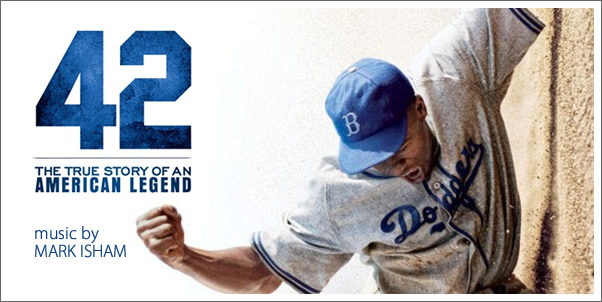
42 (Original Motion Picture Score) by Mark Isham - Review

42 (Original Motion Picture Score) by Mark Isham - Review


Americana Legend
Review by Steven Sharratt

42 is the re-telling of the true story of Jackie Robinson, an African-American baseball player who became a sporting hero despite having to endure unrelenting racism on and off the field. The film mainly focuses on the 1947 Brooklyn Dodgers season and stars Chadwick Boseman as Jackie and Harrison Ford as Branch Rickey.

Legendary composer MARK ISHAM was brought on board to score the music for the film. Isham, now in his 4th decade of film composition is famous for many great scores such as POINT BREAK (1991), A RIVER RUNS THROUGH IT (1992), BLADE (1996), THE BLACK DAHLIA (2006) and the Oscar nominated CRASH (2006).

Isham uses this vast experience to create a typical Americana score for ‘42’. To achieve this he opts for one of his trademark trumpet solos which, as to be expected, are performed faultlessly. Light woodwinds, strings and piano complete the sound to add a somber but respectful tone with which to follow Jackie Robinson’s unlikely and difficult journey to fame. The main problem for the listener is the fact that the thematic ideas first hinted at are never fully developed until the end ...

Monday, July 08, 2013

Emperor (Soundtrack) by Alex Heffes - Review

Emperor (Soundtrack) by Alex Heffes - Review

Imperial Melodies
Review by Steven Sharratt

EMPEROR is a film set in the days immediately following the Japanese surrender at the end of World War II and is based on the book "His Majesty’s Salvation" by Shiro Okamoto. It follows the true story of General Bonner Fellers (played by Matthew Fox) who is working for General Douglas MacArthur (Tommy Lee Jones) as a Japanese expert. He is tasked with investigating what role Emperor Hirohito had to play in World War II and whether he should be tried as a war criminal. Interwoven with this is Fellers’ emotional search for Aya, a Japanese exchange student he met years earlier.

EMPEROR was scored by ALEX HEFFES, a British composer mainly known for his work in TV and documentaries. However, in more recent years he has become a more recognised face in film by providing critically acclaimed scores for films like THE LAST KING OF SCOTLAND (2006), STATE OF PLAY (2009) and THE RITE (2011). This is mainly in part to his ability to write for a full orchestra with interestingly melodies – something we’re finding more of a rarity in Hollywood these days.  So it’s great to see Heffes’ use these talents again here.